Symbols of the Camino de Santiago: Scallop Shell, Yellow Arrow and Botafumeiro
Discover the meaning and history of the Camino's symbols: the scallop shell, Elías Valiña's yellow arrows, the botafumeiro, the cross of Santiago and the pilgrim's staff.
The symbols that give the Camino its soul
When you walk to Santiago, you don't just walk through landscapes: you walk through symbols. A shell sewn onto a backpack, an arrow painted on a stone, a credential stamped at the end of the day, the perfumed smoke that fills the cathedral. Each one carries centuries of history, and understanding them completely changes the experience.
At Casa Andaina, in the heart of Palas de Rei and right on the French Way, we watch pilgrims pass by every day with the scallop shell at their neck. Many don't know where that gesture comes from. This article tells the real story of the great Jacobean symbols, without inflated legends and with what is actually known.
The scallop shell: the universal symbol of the pilgrim
The scallop shell (*Pecten maximus*) is the most recognizable emblem of the Camino. You'll find it on backpacks, on waymarkers, on façades, on city signs throughout Galicia.
Why a shell
The origin has a very concrete geographical basis: the scallop is a mollusc abundant in the Galician estuaries. The first medieval pilgrims who reached Santiago continued to the coast, to Fisterra and Muxía, and picked up a shell as physical proof of having completed the journey. There were no photos or stamps: the shell was the certificate.
Over time, it stopped being a souvenir of the return and became a badge for the outbound journey. Wearing it sewn on told innkeepers, monasteries and locals that the person was a pilgrim, entitled to hospitality and protection along the way.
The meaning of the lines
A widespread interpretation sees in the ridges of the shell the many routes that set off from different points across Europe and converge on a single point: Santiago. It's a lovely and useful image, though it's worth knowing it's a later symbolic reading, not a medieval dogma.
Today the shell remains your silent ID card. If you walk the last 100 km, hang it on from day one: it's part of the ritual.
The yellow arrows: the story of Elías Valiña
If the shell is the oldest symbol, the yellow arrow is the most practical and the most modern. Without it, thousands of pilgrims would get lost every year.
A priest, a tin of paint and an instinct
The yellow arrows are not medieval: they were born in the 1980s thanks to Father Elías Valiña Sampedro, parish priest of O Cebreiro (Lugo) and a scholar of the Camino. At a time when the route was almost forgotten and poorly signposted, Valiña travelled the trail with tins of yellow paint —reportedly left over from road works— marking the itinerary with arrows on stones, trees, walls and posts.
There's a famous anecdote: the Guardia Civil, seeing him painting arrows near the Pyrenees, asked what he was doing. His reply was something like he was preparing an invasion. He was right: the peaceful invasion of pilgrims that would follow.
How to read them today
- The arrow always points towards Santiago. Follow it and you won't get lost.
- At tricky junctions you'll see several arrows or the official waymarker with the shell.
- Be wary of "alternative" arrows in other colours: they're usually commercial detours towards a specific bar or hostel.
Valiña died in 1989, but his legacy underpins the entire French Way today. Every arrow you see between Palas de Rei, Melide and Arzúa is a direct heir of that visionary priest.
The botafumeiro: the cathedral's giant censer
Reaching Santiago and watching the botafumeiro fly is, for many, the emotional finale of the journey.
What it is and how much it weighs
It is one of the largest censers in the world: around 1.6 m tall and roughly 53 kg once loaded with charcoal and incense. It hangs from a complex structure of ropes and pulleys in the cathedral's transept. It is operated by eight men called tiraboleiros, who pull the ropes in a coordinated way to swing it up to impressive speeds, almost brushing the vaults.
Why it was used
The original function had a very practical side: in the Middle Ages, thousands of exhausted pilgrims slept inside the cathedral. The perfumed smoke helped to purify the air —and mask odours— in addition to its liturgical meaning as a symbol of prayer rising to heaven.
When you can see it
It doesn't fly at every mass. It runs on major feast days and when a group pays for it in advance. If you want to see it, check the cathedral's official schedule before you arrive. Not taking it for granted spares you disappointment.
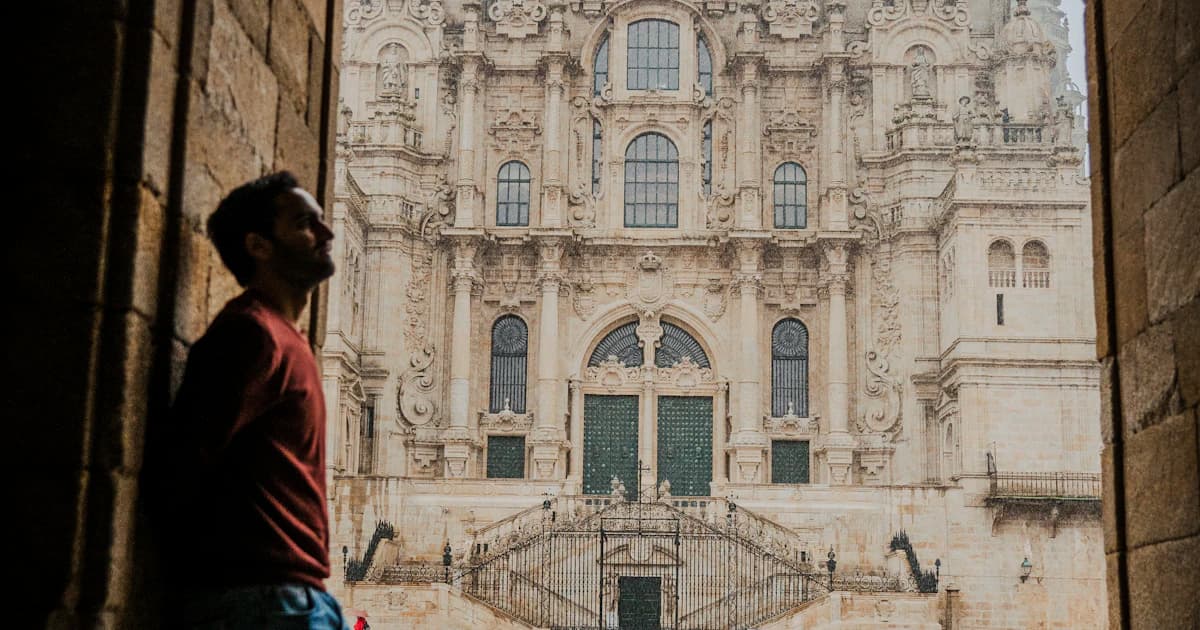
Once in Santiago, take time for the cathedral and the old town. If you plan your arrival and return well, you'll enjoy it far more; we explain it in our guide to the last 100 km and arriving in Santiago.
The cross of Santiago: the sword-shaped cross
The cross of Santiago is that red cross shaped like a sword that you'll see on flags, souvenirs and monuments all over Galicia.
Its design combines a Christian cross with a sword blade at the lower end, finished in a point. It is tied to the Order of Santiago, a medieval military and religious order that protected pilgrims and fought in the Reconquista. The red colour evokes the blood of the knights.
Very close to Palas de Rei, in Vilar de Donas, you'll find a Romanesque church that was a pantheon for knights of the Order of Santiago, with preserved medieval frescoes. It's a must-see to understand this symbol on the ground.
The staff and the gourd: the pilgrim's classic kit
No image of the medieval pilgrim is complete without the staff and the gourd.
The staff
The staff (*bordón*) is the tall wooden stick, taller than the person, that accompanied the pilgrim. It served many purposes: leaning on it uphill, keeping balance on uneven ground, testing the path and, if needed, fending off dogs or robbers. Its modern version is the trekking pole, which saves so many knees on the descents into Portomarín or Arzúa.
The gourd
The dried, hollowed-out gourd, tied to the staff, served as a water bottle. It let pilgrims carry water —or wine— in an era without light bottles. Today it's mostly a decorative symbol, but it recalls something very current: hydration is key. In summer, set off with at least a litre and a half of water.
These two elements, together with the shell and the *esclavina* (the short cape), make up the classic iconography of the pilgrim, the one you see in statues and images of Saint James the Pilgrim.
The symbol you take home: the credential and the Compostela
There's one symbol that isn't an ancient object but closes the circle: the pilgrim's credential. It's the document you stamp along the Camino and which proves you've covered it on foot, by bike or on horseback.
On reaching Santiago, with a complete credential, you can request the Compostela, the official certificate. To earn it on foot you must walk at least the last 100 km, which begin in Sarria. That's why this area —Palas de Rei included— is so busy.
If you're starting on the last 100 km, stamp your credential every day at bars, churches and accommodation. At Casa Andaina we stamp yours; we tell you about it on our pilgrim credential page and in the guide to the credential and the Compostela.
The Camino makes more sense when you know its symbols
The shell that certifies you, the yellow arrow that guides you, the botafumeiro that welcomes you, the cross that tells a centuries-old story, the staff that holds you up. They're not decorations: they're the language of the Camino. Walking while knowing them turns a hike into a meaningful pilgrimage.
If you want to go beyond the symbols and live the Camino with guided experiences, gastronomic routes through Galicia or logistics for groups, the local agency OurWay.Travel designs tailor-made trips from Palas de Rei.
Where to stay in the heart of the Camino: Casa Andaina
Casa Andaina is at Rúa Mercado 17, in the very centre of Palas de Rei, right on the French Way and 65 km from Santiago. It's the ideal base to rest between stages and soak up Jacobean culture.
- 6 bedrooms: spread across 2 independent apartments (capacity for 10 and for 5 people).
- 2 fully equipped kitchens: and 2 bathrooms with bathtubs, perfect to recover your legs.
- Fibre WiFi: , central heating and all the comforts of a rural house.
- No washing machine on site, but two launderettes 50 metres away.
Real prices and direct booking with no commissions:
- Apartment from €140/night.
- Whole house from €250/night, ideal for groups.
Book by calling +34 982 204 131 or check where to stay in Palas de Rei and our offers. We'll be waiting for you right on the Camino, with the yellow arrow passing by your door.
Planning Your Camino?
Casa Andaina in Palas de Rei — 6 bedrooms, equipped kitchen, WiFi. Book direct with no commission.