History and Legends of the Camino de Santiago: Origins and Myths
Explore the Camino's origins: the discovery of the Apostle's tomb, the Codex Calixtinus, the Holy Year (Xacobeo) and legends like the field of stars and O Cebreiro.
Why we walk to Santiago
Millions of people have walked the Camino de Santiago over the last twelve centuries, yet few know the story behind every yellow arrow. Long before it became a travel destination or a sporting challenge, the Camino was one of the great pilgrimages of medieval Christendom, on a par with Rome and Jerusalem. Understanding its origins, its legends and the texts that first put it into writing completely changes the way you walk it.
In this article we trace the discovery of the Apostle's tomb, the first book that served as a guide for pilgrims, the meaning of the Holy Year, and some of the most beautiful legends that are still alive along the route today.
The discovery of the Apostle's tomb
Tradition holds that the apostle James the Greater preached in Hispania and that, after he was beheaded in Jerusalem around the year 44, his disciples carried his body by sea to the coast of Galicia. There he was buried, and over the centuries his tomb was forgotten.
The true starting point of the story took place in the early 9th century, around the years 820-830. According to tradition, a hermit named Pelayo watched strange lights appear over a wood at a place called Libredón for several nights. He alerted Teodomiro, bishop of Iria Flavia, who came to the spot and found a tomb that he identified as that of the Apostle. King Alfonso II the Chaste travelled from Oviedo to venerate it, becoming in a sense the first pilgrim, and ordered a first church to be built over the grave.
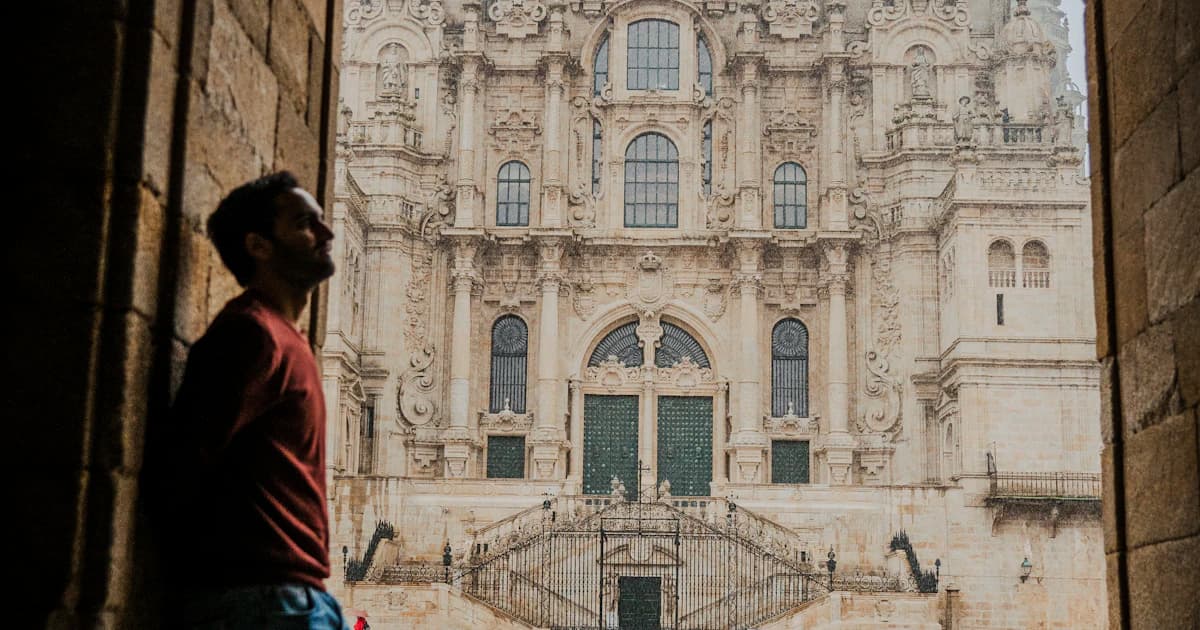
A city grew up around that tomb: Compostela. The discovery had enormous political and religious weight in a Hispania that was then divided, and soon pilgrims began arriving from all over Europe.
The "field of stars"
One of the most repeated, and most debated, explanations of the name interprets Compostela as *campus stellae*, the "field of the star", referring to the lights that guided Pelayo to the tomb. The name probably comes instead from the Latin *compositum* or *compostum* (burial ground), but the image of the field of stars has remained forever linked to the Camino and to its luminous, mysterious character.
The Codex Calixtinus: the first pilgrim's guide
In the middle of the 12th century, one of the most important manuscripts of the European Middle Ages was compiled: the Codex Calixtinus, attributed to Pope Calixtus II and kept in the cathedral of Santiago. It is a work in five books bringing together sermons, miracles of the Apostle, liturgical and musical texts, and an account of the transfer of the body.
Its most famous section is Book V, regarded as the first travel guide in history. It describes the stages of the French Way, the people and customs of each region, the good and bad water sources, the shrines worth visiting and even very practical advice for the walker. Reading it today is moving: many of those pilgrims' concerns (water, lodging, food, company) are exactly the same as ours.
The Holy Year (Xacobeo)
The Compostelan or Xacobeo Holy Year is the year in which 25 July, the feast of Saint James, falls on a Sunday. It occurs in a recurring cycle of 6, 5, 6 and 11 years. During the Holy Year the cathedral's Holy Door is opened and pilgrims can obtain the jubilee.
The tradition of the Jacobean jubilee goes back to the 12th century and was confirmed by various popes throughout the Middle Ages. Holy Years have always marked the great peaks of arrivals in Compostela, and even today they multiply the number of pilgrims walking the route.
Legends that live along the way
The Camino cannot be understood without its legends, passed down from stage to stage, giving meaning to many place names and monuments.
The miracle of O Cebreiro
In O Cebreiro, the gateway of the French Way into Galicia, the most famous eucharistic legend of the route is preserved. The story tells that, in the depths of winter, a peasant climbed up through the snow to hear Mass. The priest doubted the faith of a man who had risked so much for so little and, at that very moment, the bread and wine of the consecration turned into flesh and blood. The so-called Holy Miracle of O Cebreiro turned the small church of Santa María la Real into a place of pilgrimage, and it is said to have inspired the legend of the Galician Holy Grail.
The miracle of the hanged man and the hen
In Santo Domingo de la Calzada, in La Rioja, they tell the story of a young pilgrim unjustly hanged who survived through the saint's intercession. When his parents alerted the judge, who was about to eat a roast cock and hen, he replied that their son was as alive as those birds... which immediately stood up and crowed. That is why a live cock and hen are still kept inside the cathedral today.
The pilgrim's shell
The scallop shell is the universal symbol of the pilgrim. One legend links its origin to the arrival of the Apostle's body by sea: a knight riding along the coast fell into the water and emerged covered in shells, saved through the intervention of Saint James. Beyond the myth, the scallop served medieval pilgrims as proof that they had reached Galicia, by the sea, and as a bowl to drink from or to ask for food.
History you walk through in the final kilometres
All this history is not only in books: you walk on it. Anyone covering the final stages passes through villages steeped in the past. In Palas de Rei, the name itself ("palaces of the king") evokes old royal legends, and nearby you will find treasures such as the Pambre Castle and the Romanesque church of Vilar de Donas, once the seat of the knights of the Order of Santiago.
If you want your pilgrimage properly stamped and recognised, don't forget the pilgrim credential and the Compostela: the document that connects you directly to that medieval jubilee tradition. And to understand exactly where you stand in the last 100 km, our guide to what to see between Sarria and Santiago puts the history on the map.
Living the history, not just reading it
The best way to bring these legends to life is to walk them with someone who knows them closely. The local agency OurWay.Travel designs guided experiences and cultural and culinary routes across Galicia, perfect for uncovering the historical background of the Camino without losing the rhythm of your pilgrimage.
Where to sleep amid all this history: Casa Andaina
To soak up the history of the Camino it pays to take it slowly, and Palas de Rei (65 km from Santiago, right on the French Way) is a perfect place to do so. Casa Andaina sits in the very centre, on Rúa Mercado 17, literally on the Jacobean route.
- 6 bedrooms: across 2 independent apartments (capacity for 10 and 5 guests)
- 2 fully equipped kitchens: and 2 bathrooms with bathtubs, ideal for resting tired legs
- Fibre WiFi: and central heating
- Two laundries 50 m away (the house itself has no washing machine)
- Apartment from 140 €/night: and whole house from 250 €/night
- Direct booking, no commissions:
You can check availability and prices on our pages for where to stay in Palas de Rei and Camino de Santiago accommodation, or call us directly on +34 982 204 131. We look forward to making the history of the Camino part of your own story.
Planning Your Camino?
Casa Andaina in Palas de Rei — 6 bedrooms, equipped kitchen, WiFi. Book direct with no commission.